
ML55 AC Woes
by Gary Edwards, Technical Advisor Peachtree Chapter
This is another story of how fault codes don’t necessarily tell you what’s wrong. They typically point you in the general direction of the issue, but very often problems masquerade under misleading fault codes. If the component reporting the fault codes itself has a problem, it can get challenging.
I finally got a first generation ML, a rode-hard and put up wet 2000 ML55. After dealing with a misfire, weird ride motions over bumps, non-functional windshield wipers and a hood that wouldn’t stay open, I started driving it on local errand runs. I was particularly pleased that the AC worked well, that is until I started going on trips more than 10 minutes long. At about 10 minutes, the AC quit; that is the compressor stopped running and the air coming out of the ducts got warm! This was accompanied by a loud whining fan noise from under the hood. This summer was hot, and I needed the AC to work so I could get some use out of the car.
The first thing I do for AC issues is to hook up a set of gages. The pressures looked a little low so I added some refrigerant, however at about 10 minutes the compressor shut off so I couldn’t add any more. I got a good enough look at the pressures, though, that I could tell it wasn’t a low refrigerant charge causing my problems. I also noticed that the huge single electric radiator fan was running at maximum speed.
Next I hooked up a scanner. I saw the fault code for refrigerant pressure high, which did not make sense since I still had the gages hooked up and I could see the refrigerant pressure was certainly not high. Also, the live data showed 126 bar for the refrigerant pressure, which is not possible, the relief valve would have opened, or the system would have ruptured. This sounded like a pressure sensor failure so I ordered one.
The ML55 has a single huge variable speed electric radiator cooling fan. When the AC controller detects grossly excessive refrigerant pressure, it infers that the condenser temperature is too high and it shuts off the compressor to stop the pressure from going up. It also runs the fan at maximum speed attempting to cool the condenser to lower the refrigerant pressure. This was the reason for the fan whine I was hearing when the compressor shut off. Since an erroneous high pressure was being reported, the compressor never cut back on and the fan stayed at maximum speed.
As you would expect, the pressure sensor is part of the pressure boundary for the AC system. This means that the refrigerant must be completely removed from the system prior to replacing it. This can be done by using basic thermodynamic principles. Connecting a small tank and cooling it to below freezing after running the car to heat the AC system will result in the refrigerant migrating out of the system and condensing in the tank. After doing that, replacing the pressure sensor, recharging the system and running it, I had nice cold air – for 10 minutes – only! The pressure sensor did not fix the problem.
Reading the scanner again, I had the same refrigerant pressure high fault and the ridiculous pressure indicated by the system. I plugged in the old pressure sensor, now not connected to the system and at ambient pressure, and it said the same thing. Looking carefully at how these sensors work, they have three wires. One is a ground, one provides 5 volts from the control unit to the sensor, and the other returns a voltage signal that varies with pressure. I verified that the 5 volts was present. This left only two remaining possibilities, one was a broken wire and the other was a faulty control unit.
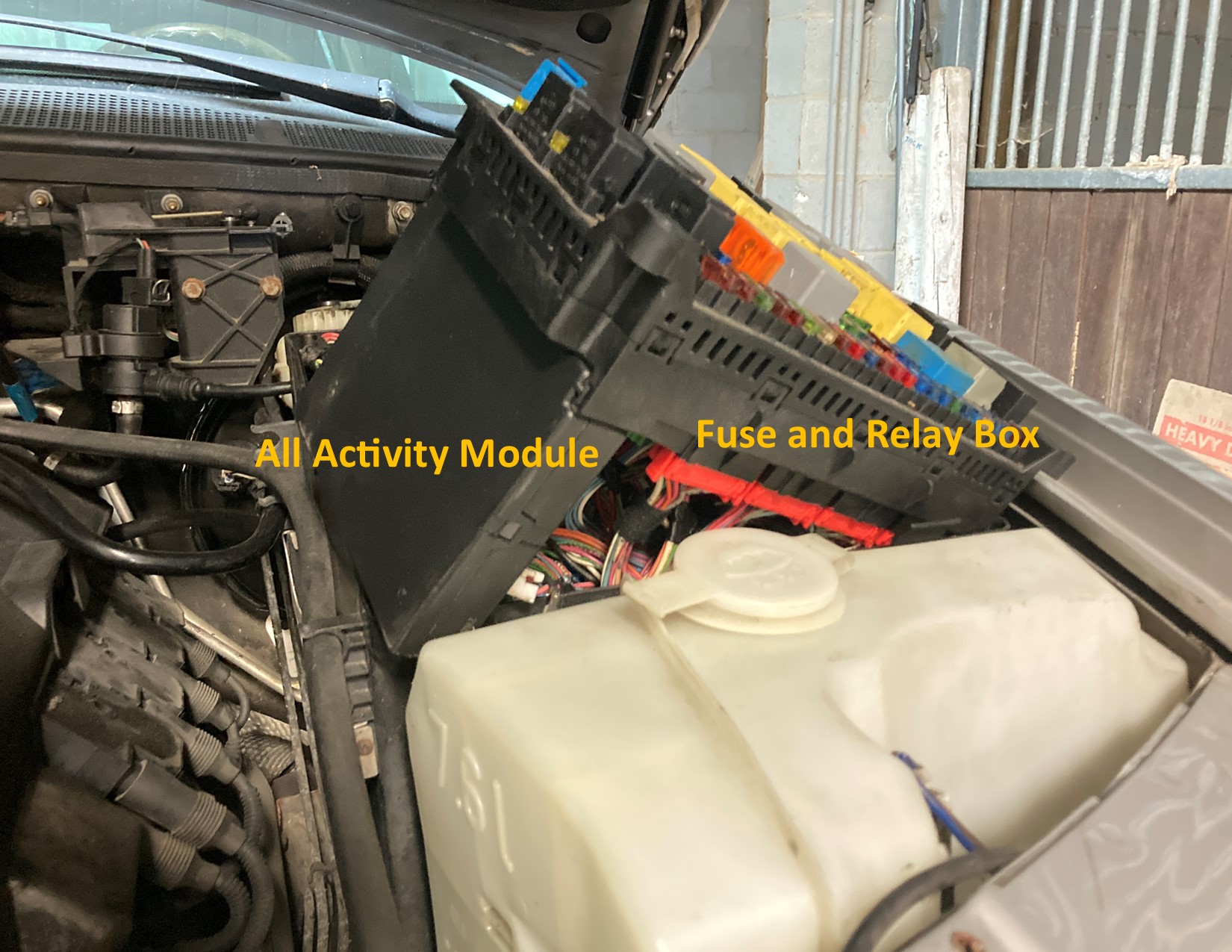
The control unit in a first generation ML is part of the All Activity Module (AAM), which consolidates a host of control functions, such as headlights, wipers and central locking. The AAM is located under the fuse box, and is quite easy to access, though removing it requires understanding how to release the latches locking it to the fuse box. I was able to find the plug and locate the pin for the signal from the pressure sensor – it measured 0 ohms from the sensor’s plug to the AAM plug. The wire was fine!
This left only one potential cause – a failed AAM. I found a used AAM with the same part number on ebay for less than $100. The forums all say that you need a STAR system to recode the AAM for that specific vehicle, but a more careful reading showed that was for the key fob to activate the central locking, and I didn’t have any key fobs so I decided to swap it and see what happened. This is pretty simple - I swapped out the AAM and I had air conditioning!
So as I mentioned above, this is another example of a fault code that doesn’t really tell you what’s wrong with the car. Live data is often very helpful, though. The excessively high pressure should have been a stronger clue had I recognized it – I doubt if the pressure sensor range goes that high which should have made me suspect the AAM from the beginning. I think I could also have ruled out a bad cable to the sensor, since I think that would look like 0 volts to the AAM, which would have given 0 pressure – it would have shut the compressor down on low refrigerant pressure but that would have given a different fault code. This was a bit frustrating, but perseverance paid off and I’ve got consistently cold AC, and a usable, though very needy, ML55.
Sponsors