
Gary's Garage - If its in its Tight
by Gary Edwards, Technical Advisor
My New Year’s Resolution was to get all my cars working. This meant getting around to working on some cars that I had set aside due to the nature of their issues. What I found on a couple of them was quite unusual and I thought this one was worth sharing.
When I bought the 1973 450SLC via on-line auction, the seller wanted me to fly out and drive it home. I could tell that the car had not been driven much recently so I prudently decided to have it shipped. As soon as the car was delivered, I noticed a loud clunking. I was able to quickly determine that it was road-speed related but I couldn’t tell whether it was front or rear. Listening as it was being driven past me allowed me to isolate it to the rear.
I jacked up the rear of the car one side at a time and found that I could hear the noise when the right rear wheel was raised and turning and could not hear it when the left rear wheel was raised and turning. It also sounded like the noise was from the differential or the inner end of the axle shaft. I thought that it was probably either the right axle shaft or the differential itself.
I sat the car aside and moved on to other projects while I waited for a used axle shaft to arrive. I also obtained a selection of the shims used to set the end play of the drive axle stub. The car sat for over 18 months while I worked on other projects.
When I finally got around to working on the car, I put it on the lift, removed the axle retaining bolt and started tapping the stubs axle out of the carrier - Whew! I had been worried about it being frozen in! I did find that the axle on the car was from a later car and used a different sized bolt than the one I had obtained. Once I verified I could move that end I shifted to the differential end. On these cars, the retaining clip for the driveshaft is inside the differential, so you must drain the differential fluid and take off the rear differential cover, and to do that you must lower the differential to access the rear cover bolts.

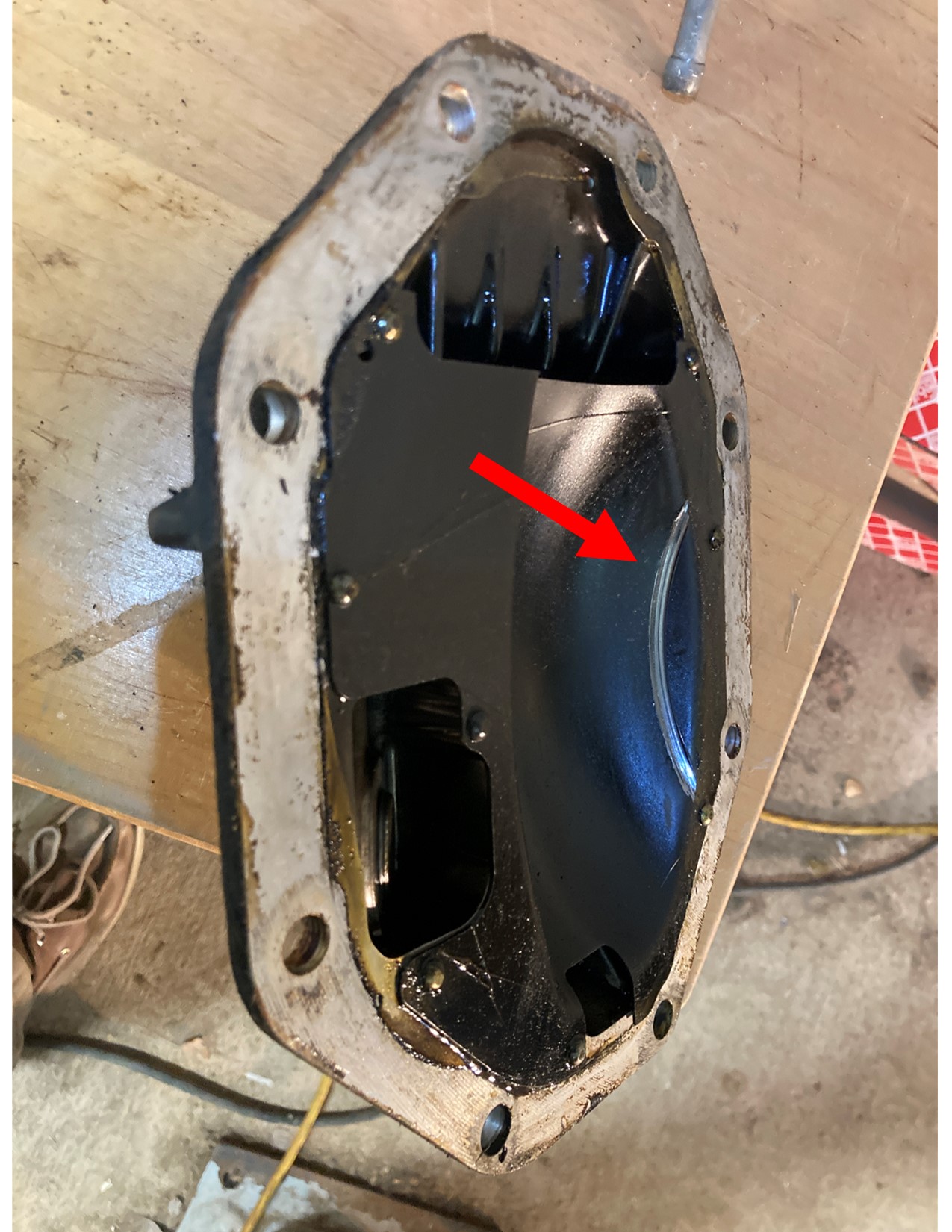
When I finally got the differential cover off, things just didn’t look right. I looked again and realized that most of the bolts holding the ring gear to the carrier had backed out. The clunking was one or more of the bolt heads hitting the inside of the differential case. One of the bolt heads was deformed enough that I could no longer get a wrench on it.
I removed that bolt, cleaned up its head and tightened all the ring gear bolts, being careful to do so in a star pattern. I buttoned it up using Dreibond to seal the cover, refilled it with fresh oil, undid all the steps about removing the driveshaft, and test drove it – it was fine!
Thinking back on the troubleshooting, I believe the noise went away when the left wheel was raised because in that case gravity worked to slide the bolts farther into their holes. Raising the right side caused the bolts to slide farther out, allowing at least one to hit the case.
Though I had considered a faulty differential as the cause, I had never thought of the ring gear bolts as the point of the failure. I suspect that someone had worked on this differential beforehand and forgotten to tighten these bolts. One of the old sayings I learned in a car maintenance class is “if it’s in it’s tight”, it’s an exceedingly poor practice to install bolts without immediately tightening them. I don’t mean to say that you put in the first bolt and immediately take it to the final torque; certainly for most parts you will need to install all the fasteners then evenly tighten them, some even have a prescribed pattern (such as head gaskets) but you should never put a bolt in and leave it for tightening later without a compelling reason. One compelling reason is for a suspension bolt where the bolt is only tightened with the car’s weight on the suspension. The person I learned this from was a LeMans Crew Chief who related an incident where a race car was sent back out onto the track without all bolts tightened - so “If it’s in, it’s tight”.
Sponsors