
Gary's Garage - 1994 Mercedes E320 Cabriolet – Trouble Shooting
My New Year’s Resolution was to get all my cars working. I really haven’t gotten there yet, but I tackled a few that I had been putting off. One was a 1994 Mercedes E320 cabriolet with ASR (Acceleration Skid Control) whose engine would not run above idle. I had purchased it this way, and probably paid too much for it, partially because of sentimentality – it had been owned by the person, my next door neighbor in Virginia and now deceased, who had originally sparked my interest in Mercedes. I bought it about 18 months previously and just let it sit until I had time to deal with it.
Once I started the troubleshooting, I learned that the car was permanently in limp home mode. The prior owner had changed the head gasket and the idle was unstable once the car was reassembled. He had been troubleshooting this, replacing the Electronic Accelerator (EA – think throttle body) and the EGAS module. Upon doing this, the car went into limp mode and no amount of troubleshooting would resolve it. He got very frustrated with the car and with Mercedes in general, selling me the car and a lot of parts.
When I started my troubleshooting, I redid some items he had already done. I swapped the MAF and replaced the EA (he had provided me with a known good EA), to no effect. I bought a used EGAS module on ebay (the EGAS module is the component that controls the EA). The EGAS module is in the passenger footwell, however replacing it didn’t solve the problem. When I was replacing the EGAS module, I noticed that there was an 8 connector UNPLUGGED near the EGAS module. I plugged this in, and suddenly limp home mode was gone! I can only surmise that the prior owner had unplugged this when replacing the EGAS module (even though there was no reason to do so) and forgot to plug it back in. I had earlier found the ABS module to be unplugged, so this was also a little odd.
But… this didn’t solve the original unstable idle problem, which returned with a vengeance. Idle stability on this car is primarily controlled by the EA, the EGAS module, and the Engine Control Unit (ECU). The ECU is the only one of these I had not replaced, but I didn’t have one. Given the prior work, I was very suspicious of a vacuum leak, which could certainly cause this problem – and is usually a lot cheaper to fix.
The strategy for troubleshooting a vacuum leak is to first do a visual inspection for obvious problems, especially broken or disconnected vacuum hoses, but I didn’t see any. This car uses vacuum to control the Exhaust Gas Recirculation valve, and I was suspicious of these lines and the EGR valve itself. An intermittent EGR valve or a leaking EGR valve could cause a fluctuating idle. I managed to test this by disconnecting and blocking the line from the EGR valve to the intake manifold, with no results.
Another strategy to detect vacuum leaks is to spray a flammable substance, such as carburetor cleaner, around potential vacuum leak sources while the engine is running. A change in RPM indicates that you’ve found the leak. This approach didn’t help me either.
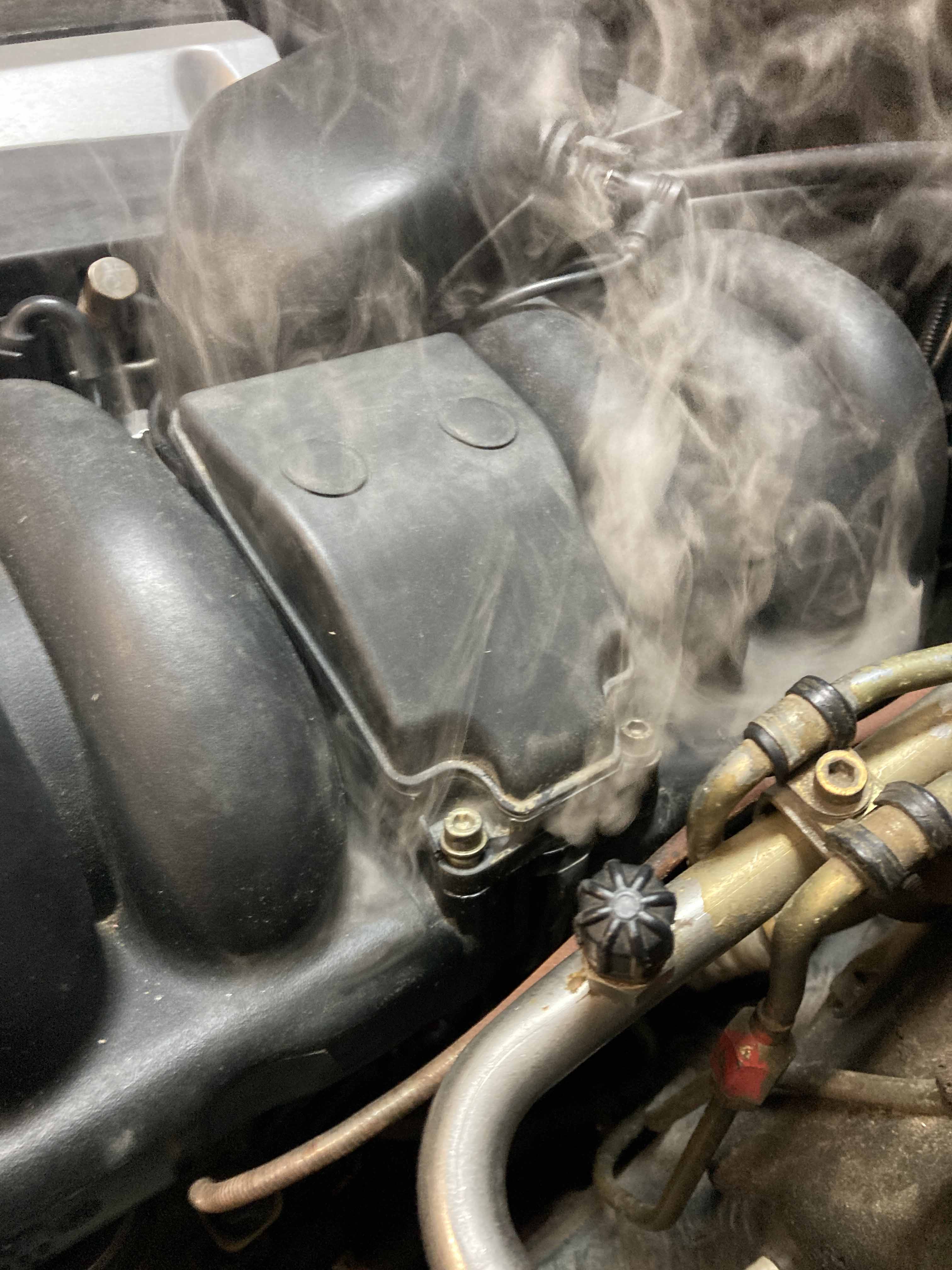
The most effective method is to use a smoke machine. To use a smoke machine, you must tap into the intake tract in a way that prevents the smoke from escaping out of the air filter. I removed the MAF sensor and tapped in there. Almost as soon as I started the smoke machine, I saw a tremendous amount of smoke coming out of the intake manifold, near the resonance flap.
This car uses a resonance flap in the intake manifold to optimize performance and efficiency. The resonance flap is activated by intake manifold vacuum, controlled using a solenoid valve. The source for the intake manifold vacuum seems to not be fully sealed by design, which was a bit perplexing as I was evaluating the quantity of smoke. I did find that if I sealed up the vacuum source (using masking tape), the idle was stable. I ordered a used resonance chamber controller on ebay (new ones do not seem to be available) and replaced the old one – the idle returned to normal!
When I bought this car, I was thinking that since I already had a 1994 E320 Cabriolet, I would be able to swap parts to troubleshoot this problem. It turns out that this one had ASR, and my previous car did not – so the parts of concern were not the same – one reason that I had put off troubleshooting this car. My success in this troubleshooting was a combination of sound troubleshooting techniques (with respect to the vacuum leak) and luck, in the case of the limp home mode. I don’t think any flow chart for limp mode would include checking for a disconnected connector in the passenger footwell.
Sponsors